
Academy · Subleink, Panama City
How to do a clean blackout
The full technique, free. Machine, needles, the four saturation methods, and which one works on each part of the body. Taught by Macabreink, who built a studio around this style.
The full video, free
Eleven minutes, start to finish: equipment, each saturation technique, and footage of real work on hand, arm and elbow.
The written guide
Everything in the video, written down so you can come back to it mid-session without scrubbing through footage.
1. Equipment
Blackout means large-scale pieces, long sessions and constant saturation. That punishes cheap gear and it punishes your hand.
I use a pen machine — an FK Irons EXO with a 4.0 stroke. I came from coil machines and I still use one occasionally, but the pen is far lighter, and that alone means my hand stops hurting and I can run much longer sessions. If you plan to make a living from this, invest in the best gear you can reach.
For needles I use Magnum 49 cartridges, Kwadron. You can work with generic needles, but you will be swapping them every one to two hours, because needles lose their edge. A blunt needle hurts more, marks less and heals worse. That was the single change that made my blackouts heal properly.
Treat healing as 50% technique and 50% gear. Neither one carries the job alone.
2. The four saturation techniques
This is where most blackouts go wrong. There is no single correct method — there are four, and each one trades speed against how much the skin suffers.
Circular
How I started. It saturates, but it hurts the skin badly: slower healing, and it used to leave a faint scar that only faded over time. It is also the slowest of the four.
Zigzag
Saturates fast. On healing it leaves visible streaks — I liked the look, and over time the ink spreads a little and most of them disappear, though the pattern still shows in places. Good where you are not blacking out the entire surface.
Sweep — the one I use
My favourite today, and the one I tell anyone starting out to learn first. The tattoos heal beautifully with it. Once you own this one, go experiment with the others, because you will need them on certain body parts whether you like it or not.
Dotwork
For fingers. If you sweep a finger it looks black at first and then lifts. Dotwork is what holds there.
3. Which technique each body area needs
- Fingers — dotwork. Sweeping will not hold.
- Shoulder — sweep. Zigzag tears that skin up too easily. Circular works but is slower, so the skin suffers more.
- Hand — needle tilted to 30–40°, fill in zigzag, then sweep over the rest.
- Elbow — roll the skin to one side with your free hand so the needle never touches bone. The needle stays tilted, never straight on. Then saturate in passes, with patience.
4. Running the machine
Voltage. I run around 8, sometimes 8.5 or 9. On a different machine, high might mean 6 — it depends on the machine, not on the number. High voltage means your hand has to move fast to match it.
Needle depth. I run 4 to 5 mm out, which is more than the usual 3 mm. But I am not driving it in: I let the needle enter only as far as it should, under the weight of the machine itself.
Grip. Do not press the machine into the skin. The weight of the machine does the work; you only move it. Watch the grip in the video — I rest on my little finger and put cream on the arm so the machine glides instead of dragging.
Checking. Wipe clean and look. If an area did not take, you fix it as you go rather than at the end.
From real sessions
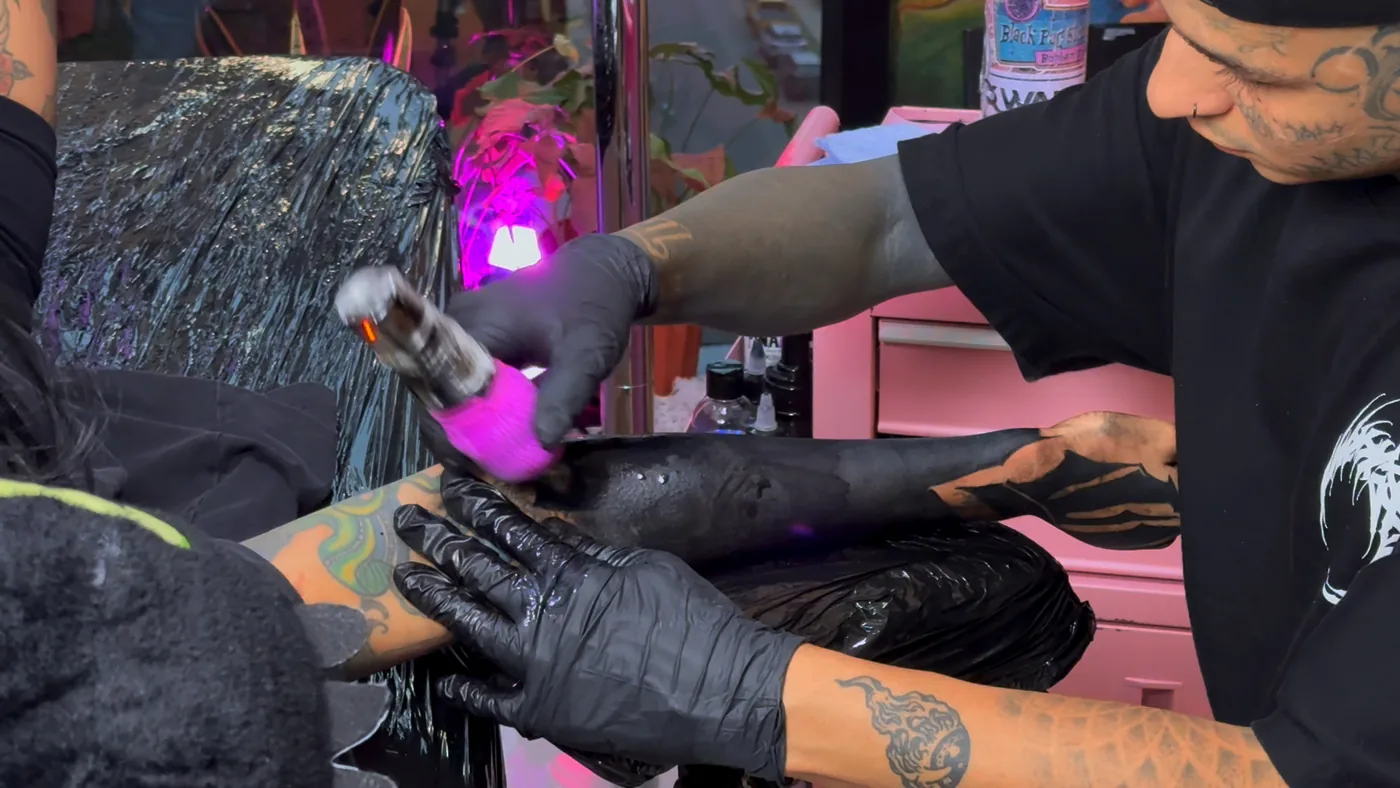
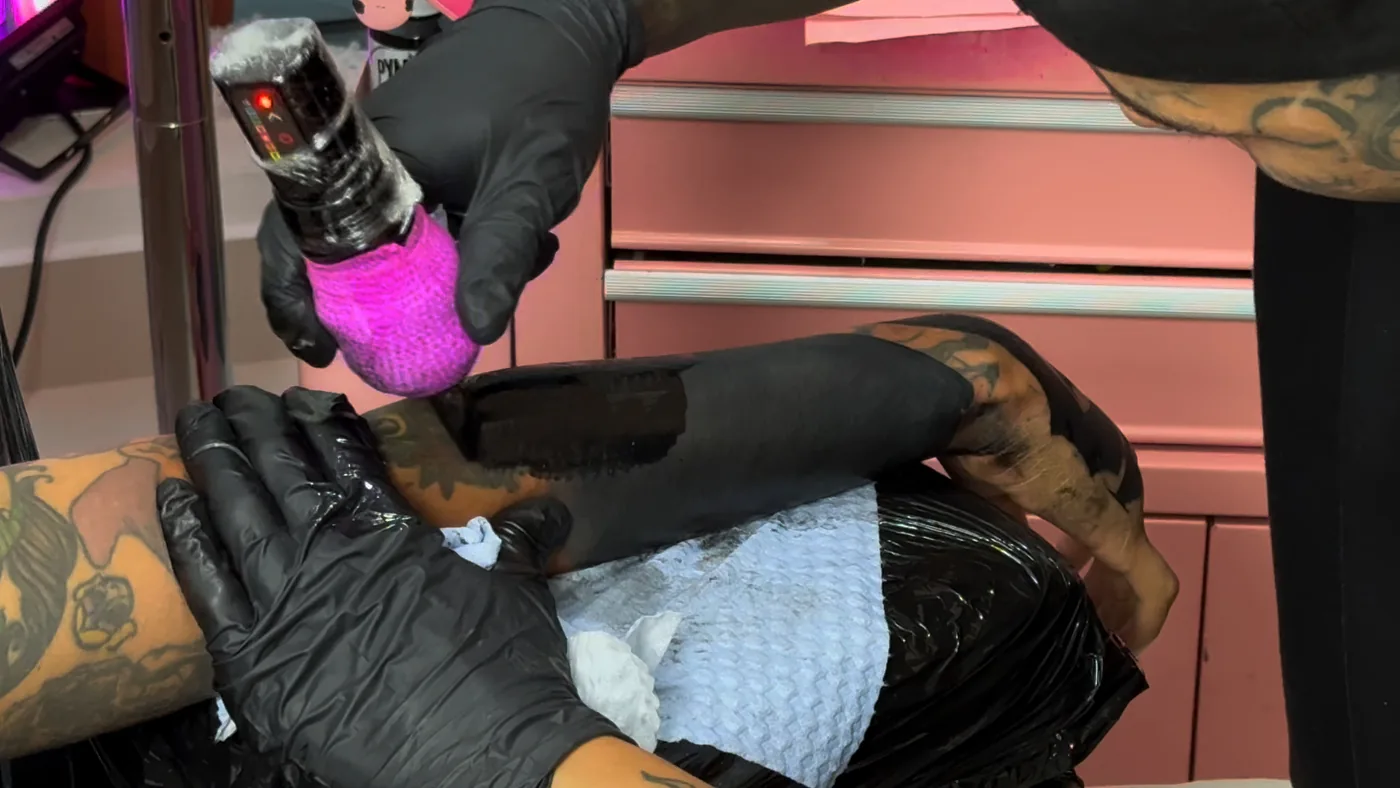
Who is teaching this
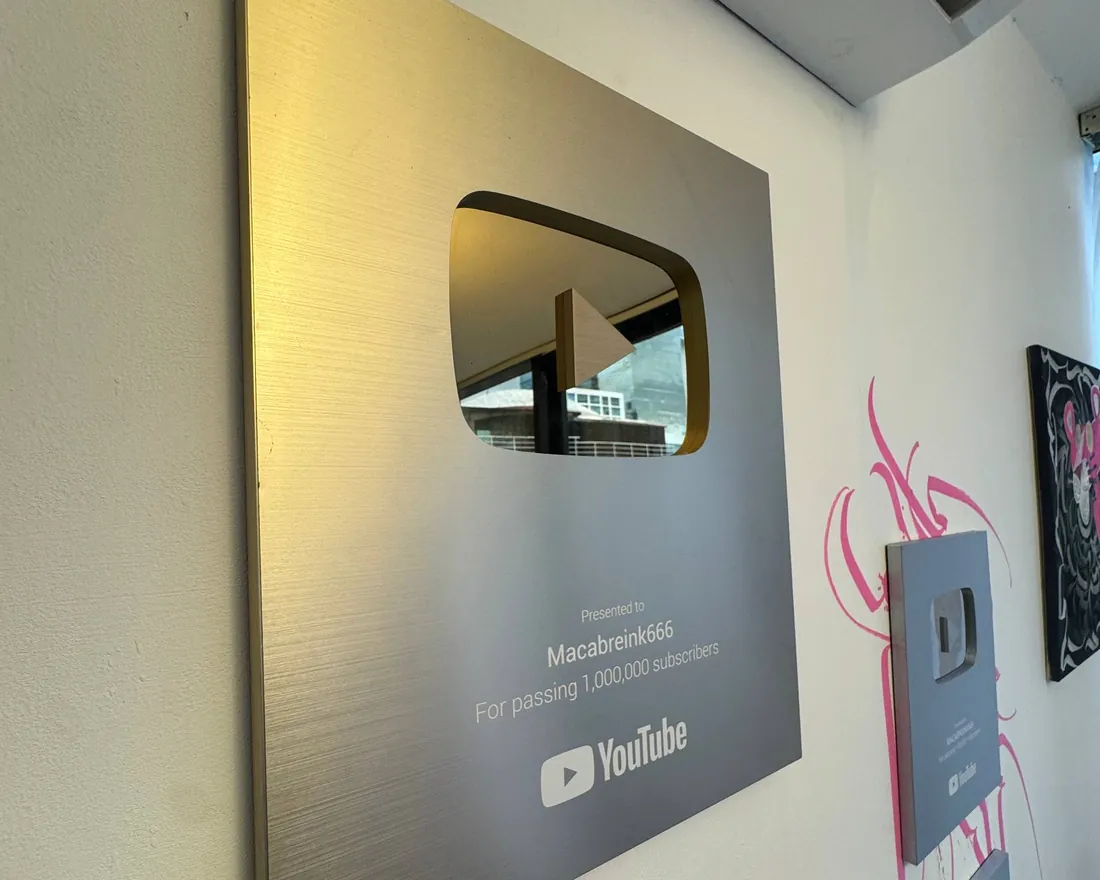
Macabreink is the founder of Subleink Tattoo Shop Art Gallery in Panama City and specialises in abstract freehand lettering fused with blackout. He was the first in Panama to combine solid blackout with abstract lettering and clean artistic finishing, and he completes a full arm — wrist to shoulder — in a single 3 to 4 hour session, or a full leg in up to 7, rather than splitting it across sittings.
Questions from the comments
Straight or curved needles for blackout?
I work with Magnum 49 cartridges. What matters more than the curve is that the needle is sharp: a blunt needle marks less and damages the skin more, so change it often if you are on generic cartridges.
My machine takes forever to pigment. What do I check?
Three things, in this order: the needle (if it is blunt or low quality, nothing else will fix it), the voltage for that specific machine, and your speed — if you run high voltage you have to move fast. Cheap cartridges are usually the culprit.
Does the technique change by body area?
Yes, and that is the part most people skip. Fingers need dotwork, the shoulder needs sweep, the hand takes a tilted needle with zigzag, and the elbow needs the skin rolled aside so the needle never hits bone.
How do I stop blackouts healing patchy?
Half of it is technique, half is gear. Sweep heals the best of the four techniques. Beyond that: sharp needles, let the machine's weight set the depth instead of pressing, and wipe and check as you go so you catch thin areas before you finish.
Want me to look at your work directly?
The video and this guide are free and always will be. If you want to go further than that, I teach a two-hour private class, one on one, over Google Meet — or in person at the studio in Panama City if you are here.
We work on what you actually need: your machine settings, your technique, the areas that are not healing right, your sequence of work. Tell me where you are and what is failing, and I will tell you if a class makes sense for you before you pay anything.